
updated 10/07/2026
Marcus G. Yeo
The Variable Component-Contribution model
Proposal: The Variable Component-Contribution (VCC) model calculates and graphically depicts student engagement based on affective, cognitive, and psychomotor testing. It can be used to plot engagement, assess the impact of delivery strategies, and direct the design and facilitation of future lessons. Rationale, tools for measurement and analysis, strategies, and activities for implementation are presented.
Rationale: A number of existing models include motivation and cognition as levers for engagement, so this piece will focus on the separation of active learning into reflection (cognition) and action (psychomotor). Psychomotor being defined as all interaction with subject matter or learning environment via the human interface.
To start, there are numerous studies which show physical activity’s ability to increase cognitive functioning (Mualem et al., 2018), indicating the existence of a psychomotor lever.
Adding a social component, Taylor and Marienau (2016) looked at the collected works of Brookfield, Fahim, and Wilbur, concluding “brief venture into the unknown will trigger mildly increased adrenaline or cortisol production, which can enhance learning.” Getting up and moving in a social setting can improve engagement.
The pandemic of 2019 afforded an opportunity to compare the engagement of online versus in-person delivery. A study by Raes (2021) “did not find any significant differences between physical and remote presence regarding conceptual understanding, yet significant differences were found in regard of affective engagement in favour of the on-site students and remote students having the opportunity to interact.” Here mere physical presence is seen to improve engagement.
This is a departure from the Barkley and Major (2020) model which views engagement as a mental state, the product of motivation (affective) and active learning (cognitive). Active learning defined as “doing what we think and thinking about what we are doing.” (Bonwell & Eison, 1991). Separating active learning into its constituent parts, reflection and action, acknowledges the influence of the human interface on engagement, and allows for greater refinement in tracking student needs.
Another contemporary, Fredricks’ et al. (2004) three-component model, is comprised of cognitive, emotional, and behavioural engagement. The VCC model differs in that it does not measure the exhibition of specific learned behaviours, but rather the student’s level of physical interaction with task and/or peers. It’s the desirable difficulty (Bjork) of generation via the human interface that improves engagement, by making the work tangible and personal. It improves engagement by feeding a sense of self-worth, showing progress, and proving theory.
The Variable Component-Contribution (VCC) model: Student engagement has three components; motivation (affective), reflection (cognitive), and action (psychomotor). Expressed as an intensity on a scale of zero to five, and depicted as spheres of influence, the components equally overlapped produce realms of engagement.
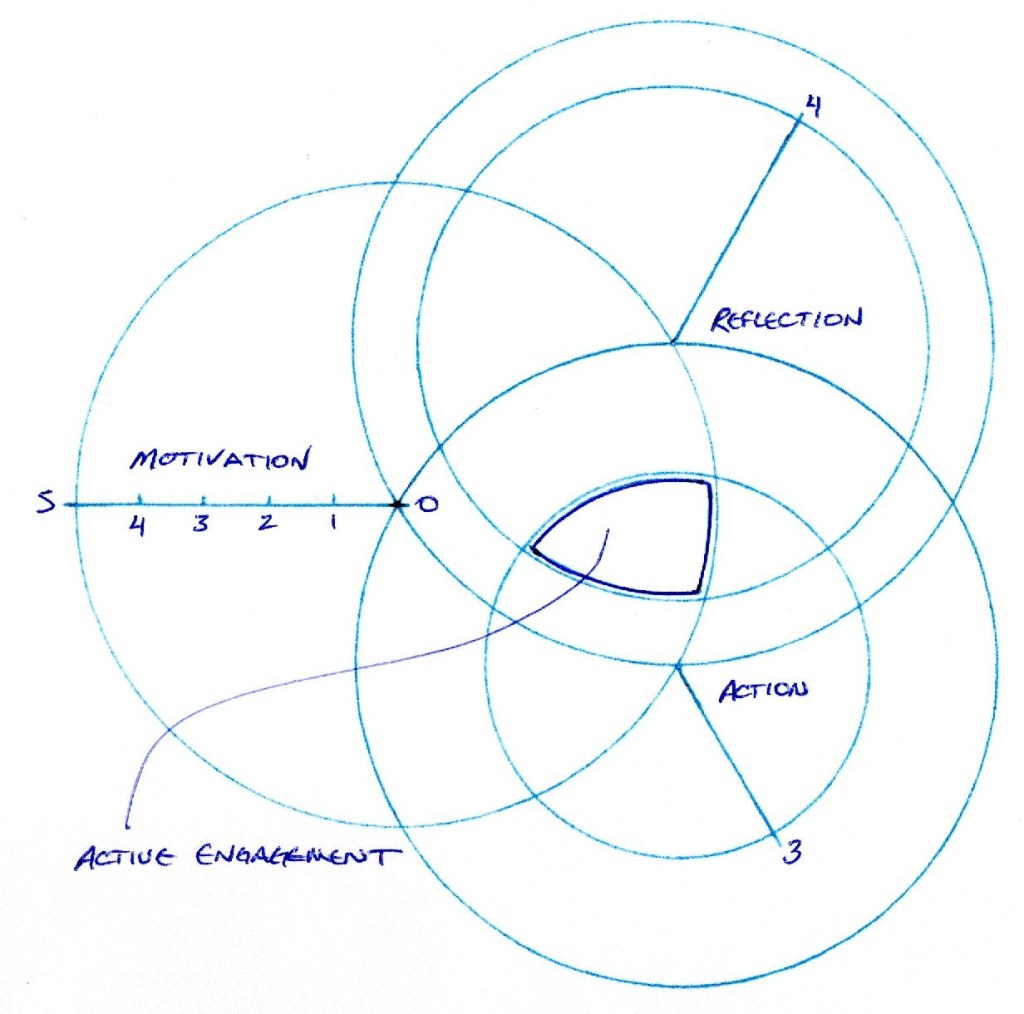
The VCC model overcomes the argument against a traditional Venn diagram, only expressing overlap, by introducing intensities of influence. A departure from the Fredricks et al. (2004) wheel of engagement, and the double helix of Barkley and Major (2020), this three-component model affords greater accuracy in plotting level and predominant types of engagement.
Types of Engagement:
Active Engagement is the combined forces of motivation, reflection, and action. It is where learning occurs.
Passive Engagement lacks at least one component, and doesn’t contribute to learning.
- Automated Engagement is motivated action without reflection.
- Philosophical Engagement is motivated reflection, but no action.
- Practical Engagement is action and reflection, without motivation.
Levels of force:
Motivation Reflection Action
0 Apathy 0 Ignorance 0 Absent
1 Concern 1 Awareness 1 Still
2 Inclination 2 Understanding 2 Active
3 Investment 3 Selection 3 Proficient
4 Passion 4 Deconstruction 4 Masterful
5 Zeal 5 Invention 5 Flowing
Measurement Tools: Two quizzes and one checklist are used to determine intensity of force. The quiz questions are designed to increase in difficulty, completion indicating increased engagement. The checklist follows a marking guide.
Motivation quiz
- T/F – True/False/Undecided. Circle one.
- Multiple Choice
- Subject matters?
- a. Yes.
- b. Sort of.
- c. Not really.
- d. No.
- Subject matters?
- Matching – Link effort to outcome. Here students choose between intrinsic and extrinsic motivators.
- Short Answer – List as many advantages as possible.
- Analogy – Subject is like?
Reflective quiz
- T/F – Subject is logical?
- Multiple Choice
- Stem
- a.
- b.
- c.
- d.
- Stem
- Matching – What causes defects?
- Short Answer – How can you improve?
- Analogy – Subject is like?
Action checklist
- Absent
- Still
- Active
- Masterful
- Flowing
Calculating Engagement:
Product of all components present.
Strategies
The U-shaped Classroom. Good engagement is enthusiastic participation and reflection. It’s seen in posture, eye contact, and reaction time. It is heard it in their answers, and identified it by their questions. They display engagement through physical output- be it a gesture, remark, or submission. A classroom where every student can be seen and interact easily reduces barriers, and allows the instructor to provide individual focus. It promotes cohesiveness.
Feel, Think, Do. “Motivation is the portal to engagement” (Barkley & Major, 2020). Though not the only way to improve engagement, it is the best starting point. First, explain why it’s valuable (affective)- motivate them to want to do the thing. Next, prepare them for/talk about/reflect upon how they find success (cognitive). Then, demonstrate it can be done, and let them take action (psychomotor). Feel, Think, Do.
Activities
Motivation:
- Bonus Round (students state benefits)
- ROI (have students tie efforts to aspects/forms of success, calculate the actual cost, explain how it saves time- cannot make more)
- Imaging Success – create a plan for adoption and refinement (use circle worksheet)
Reflection:
- 3-2-1 Bridge (self-directed learner)
- Seven-Word Summary
- Why Five Times
Action:
- Bilateral Transfer
- Perfect Form
- The Ragged Edge – defining the point of over-work
- Finding Calm – creating a distraction free space, tie to no outcome, disinvestment
Philosophical:
- Y/N and Why? Take a position and defend it
- Antithesis – argue from the opposite point of view
- Free Radicals – challenge assumptions
Automated:
- Follow the Leader
- Group Work
- Synchronicity
- Team Building
Practical:
- Instant Replay – video actions and analysis.
- The Shortest Path (process refinement)
- Question Perceptions – what actually happened?
Active:
- Who wants to go home early? – a quiz game where any student that answers ten questions correctly, may leave early if they so choose.
- Sell it! – student’s lobby in favour of the learning
- Mentoring – assign a stronger student to one that is struggling.
References
Barkley, E.F. & Major, C.H. (2020). Student engagement techniques: A handbook for college faculty (2nd ed.). New York: Wiley Jossey-Bass.
Bjork, R. A. (1994). Memory and metamemory considerations in the training of human beings. In J. Metcalfe & A. Shimamura (Eds.), Metacognition: Knowing about knowing (pp. 185–205). MIT Press.
Bonwell, C. C., & Eison, J.A. (1991) Active learning: Creating excitement in the classroom. Washington, DC: School of Education and Human Development, George Washington University.
Fredericks, J. A., Blumenfeld, P.C., & Paris, A. H. (2004). School engagement: Potential of the concept, state of the evidence. Review of Educational Research, 74(1), 59-109.
Mualem, R., Leisman, G., Zbedat, Y., Ganem, S., Mualem, O., Amaria, M., Kozle, A., Khayat-Moughrabi, S., & Ornai, A. (2018). The Effect of Movement on Cognitive Performance. Frontiers in public health, 6, 100. https://doi.org/10.3389/fpubh.2018.00100
Taylor, K., & Marienau, C. (2016). Facilitating learning with the adult brain in mind: A conceptual and practical guide. Jossey-Bass.
Raes, A. (2021). Exploring Student and Teacher Experiences in Hybrid Learning Environments: Does Presence Matter? Postdigital Science and Education. 4. 138-159. 10.1007/s42438-021-00274-0.
Intellectual Disclosure: No generative AI was used in the creation of this document.
 Greater49 Coachworks